
PAY. does not always know what your customer has purchased online. Due to privacy law, that is a matter between the customer (the payer) and you (the seller of the product or provider of your services). If your customer has a complaint about your services, a question about their payment, or the delivery of goods, your company is the first point of contact. Because PAY.'s company name is shown alongside your trade name in the statement description, we regularly receive consumer questions.
The payer (your customer) can, via the form on "Paid via Stichting Pay.nl" look up their payment. The page on which the result is published contains, in addition to the payment information, your contact details as well. That is why it is important that your contact information is in order. In this article we explain how you manage your contact details. We also explain the dispute process.
Looking up a payment
Looking up a payment. Contacting the seller and explaining the dispute process.
1. Looking up a payment
As you were able to see in the video, a consumer can request your company's contact details via the form on "Paid via Stichting PAY.nl". This is only possible if you make your contact details publicly available. If you do not do this, you run the risk of a dispute.
Adding contact details to the PAY. Admin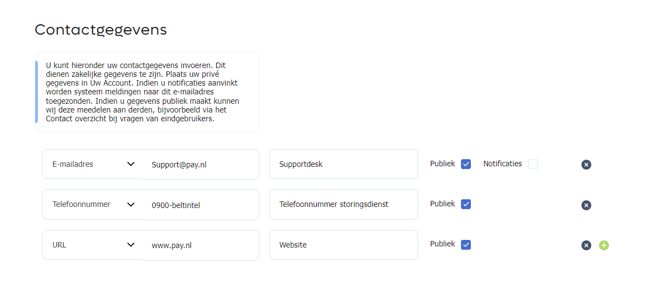
Your contact details in the Admin
To manage the contact details, click the button Merchant and then on the tab Company information. Now scroll down until you reach the heading "Contact details".
Here you can enter your contact details. These must be business details. Place your personal details in your private account. If you make your details public, we may share this information with third parties, for example via the contact overview for end-user questions.
To make your contact details available, you must select the checkbox Public and save your change. If you want to make your website address, contact phone number, and the email address of your customer service publicly available, you need to add 3 lines in the menu. You can add a new line by clicking the + icon.
2. What is a dispute?
Dispute customer view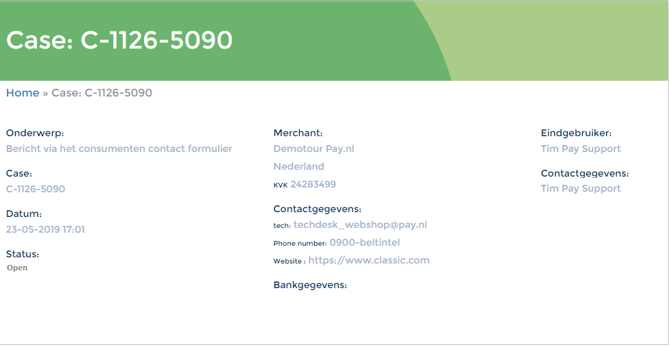
Your customer can, via the form on "Paid via Stichting Pay.nl", request a webshop's contact details up to 35 days after the purchase. We then provide the information you are legally required to state on your website, as well as the public contact details you have provided. If the customer does not receive a response using this information, a dispute can be started. It is also possible to call PAY. on the consumer line (0900-payinfo).
If you do not respond to the customer or do not resolve the issue satisfactorily, PAY. offers the option, via the form "Paid via Stichting Pay.nl", to start a dispute. Your customer files a complaint against your organization via PAY. if, for example, goods were not delivered even though the customer paid for them.
As soon as your customer starts a dispute, you will receive an email about it. The confirmation email states that as a PAY. merchant, you have 7 days to respond. If you do not respond to a dispute within 7 days, a PAY. employee will contact you. We can also then settle the dispute ourselves (we determine whether the complaint is justified). If you have many disputes, PAY. may charge costs for this. It can also happen that PAY. deems you unsuitable to work with us in the future (read our acceptance policy)
3. How do I handle a dispute?
Disputes overview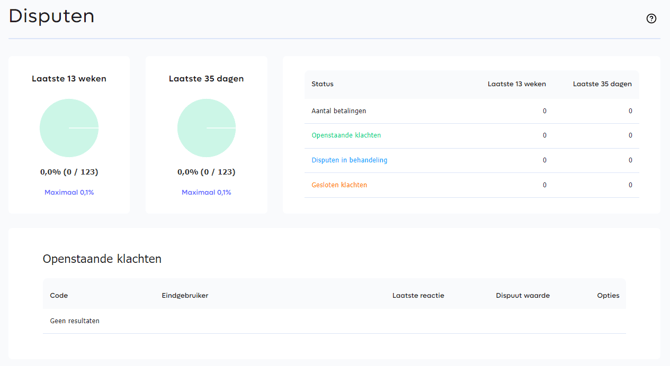
The disputes overview
If your customer has started a dispute, we will inform you by email. In this automated notification we inform you that a dispute is waiting in our PAY. Admin. You can find the pending dispute by logging in and then clicking the tabs Transactionsand Disputes. On the disputes page we show 3 different overviews:
-
Open disputes: If you have just received a notification that a dispute is waiting, click the button View in the column Options
-
Disputes in progress: If you have responded to a pending dispute and are in conversation with the customer, we show the dispute in this overview. You open the dispute by clicking the button View in the column Options
-
Closed disputes: Once you have resolved the dispute, it is closed by you or the customer. Closed disputes remain available in the Closed disputes overview. You open the dispute by clicking the button View in the column
Managing disputes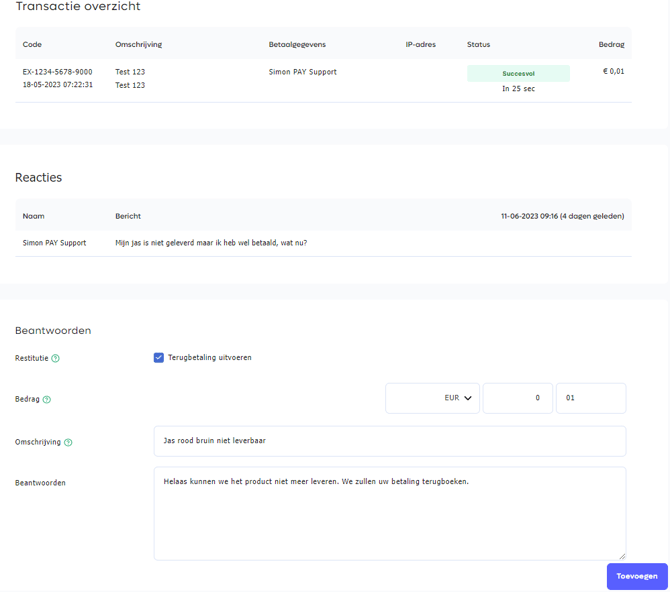
Handling the dispute
Once you have opened the dispute, we show several overviews with information. These are divided into:
-
Complaint: In this overview we show internal information such as a Complaint code, End-user information, the Dispute value and the status.
-
Transaction overview: In the Transaction overview, we show the transactions the dispute concerns. By clicking the ID you can open the Transaction information pop-up. This contains all transaction information. Naturally, you will find the same transaction information in our general transaction overviews.
-
Responses: This overview shows the conversation between you and the customer. If you have replied to the dispute and the customer responds to this message, we update the Responses overview.
-
Reply: As a Payment Service Provider, we generally expect you to resolve the dispute by communicating with the customer. This can be done via external communication channels or via this dispute. If you have resolved the issue via an external communication channel, respond to the dispute with a message. The customer receives this as evidence, after which they can close the dispute.
-
-
Refund: This is not a mandatory field. If there is no refund involved, leave this field empty. If the customer expects a refund, you can refund the transaction directly (partially) to the customer. Always enter a reference. This reference is used with the refund and, where possible, placed on the account holder's (customer's) statement.
-
Reply: You can communicate with the customer via this field. Enter your message here and click Add. If you have resolved the dispute to your satisfaction and the customer agrees, you can ask the customer to close the dispute.
-
-
If you were the last to respond to a message and the customer no longer responds, we will assume after 7 days that the dispute has been resolved. We will then close the dispute.
4. Reputation
Adding an employee
Complaints are not enjoyable for anyone. As a merchant, you would rather focus on running your webshop as effectively as possible. Unfortunately, a dissatisfied customer can quickly put a negative stamp on your online image by sharing a bad review on Facebook, Trustpilot, or klacht.nl.
It can also happen that there is no complaint at all, but rather uncertainty on the customer's side. Sometimes a complaint is started after three days, while the ordered product has a delivery time of 5 working days. In such cases, it is important that your webshop is easily reachable and communicates important information clearly.
A good reputation is essential for PAY. We like to work with merchants who have a good reputation (few complaints), so that your potential customer, through increased trust, is more likely to proceed with a payment. That is why we also want to relieve you of concerns in this area.
Our dispute system allows your customers to contact you in a safe and user-friendly way. This can, for example, be for a complaint from your customer about products not delivered. By using the dispute system, a negative online review can be prevented.
5. Setting up notifications
This is where you can find the notification configuration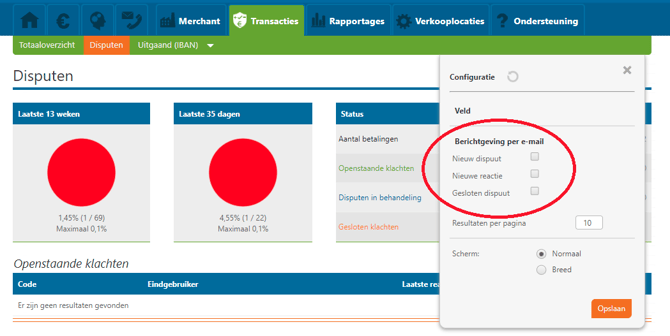
Inviting an employee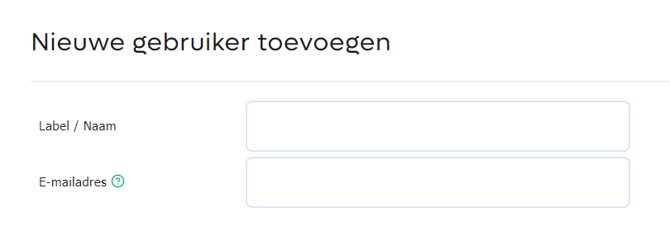
Setting up notifications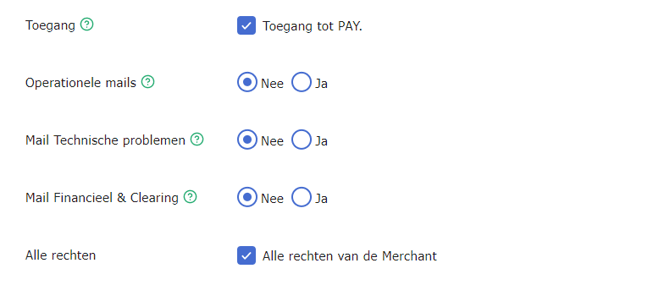
To stay informed about incoming complaints in the dispute system, it is possible to enable email notifications. Activate the option: Operational emails for the user, or via Transactions > Disputes > click Configuration and enable the notification types.
See the documentation to add additional users and how you can activate notifications for complaints in the dispute system for one or more users in your merchant account, or contact your account manager.
6. Arbitration
If you leave a dispute unanswered for an extended period, PAY. has the option to reverse the payment.
This can be done 7 days after the last response under the Pioneer and Professional package. With every response from either of the two parties, this period is extended by 7 days.
If you use the Business package, your account manager can get in touch to support you in handling a dispute.