
That's why every partner, vendor, or merchant (from the Business package onward) has a relationship manager at PAY. Not as an extra layer, but as the director of the relationship: someone who knows what's going on, connects the right people, and makes sure we move forward together.
One relationship, the right expertise
A relationship manager doesn't need to have the answer to every technical, operational, or compliance question themselves. In fact, that's what we have specialists for.
The relationship manager makes sure a question reaches the right specialist, helps with context where needed, and keeps track of progress. This way, we combine personal contact with the knowledge of the entire PAY. organization.
That also means knowledge doesn't stay with just one person. We record information in documentation, processes, and knowledge bases, so partners and customers always have access to the same high-quality information.
For merchants: the bridge to PAY.
For merchants, the relationship manager is primarily the bridge to PAY.'s organization
He knows the world of payments, knows how PAY. works, and knows our processes. He can answer many practical questions directly. He also speaks with entrepreneurs every day and knows how other merchants tackle similar challenges. That experience helps him think along quickly and sometimes offer a different perspective.
But a relationship manager is deliberately not a specialist in everything. Within PAY. we have experts in areas including operations, risk, compliance, technology, and products. The strength of the relationship manager lies precisely in the overview: knowing who you need, providing the right context, and making sure you get access to the people who can help you further.
Think of the relationship manager as a generalist standing beside you. Someone who knows your organization, understands what's going on, and can make the right connections internally.
The principle here is: urgency when necessary, thoroughness when possible.
Sometimes things need to move fast. An incident has a major impact, multiple departments are needed, or a decision has to be made on short notice. In these cases, the relationship manager helps bring the right people together and makes the urgency clear internally.
But not everything is urgent. Often it's better to carefully investigate a question, bring in the right specialist, and arrive at a solution that also works in the long term.
You can therefore also think of a relationship manager as a kind of insurance. If everything is going well, the intention is that you need him as little as possible. Support answers questions, Operations carries out processes, and our specialists do what they're good at. The relationship manager doesn't need to get in the way unnecessarily.
But sometimes things don't go as expected. A question goes unanswered, a situation affects multiple departments, or the impact on your business requires extra attention. In those cases, it's good to have someone who knows PAY. from the inside, understands your situation, and knows which doors need to be opened.
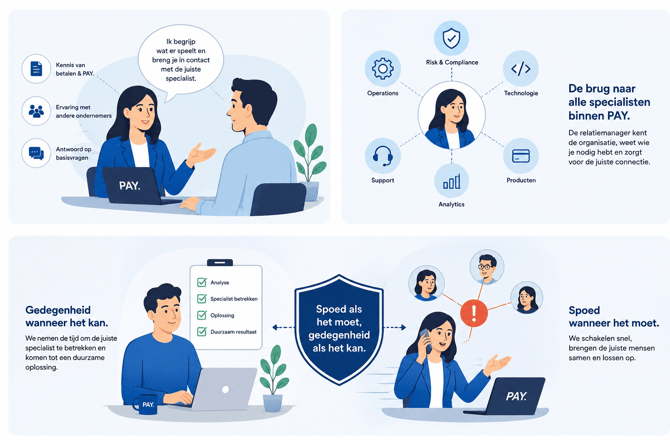
That's where the value of the relationship manager lies: not wanting to solve everything yourself, but making sure the right people get moving at the right time.
For vendors: from supplier to partnership
With vendors, the emphasis is on a strong and professional partnership. A payment platform consists of many different products, technologies, and parties. Good communication with vendors is therefore essential, especially when new products are being developed or existing solutions are changing.
The relationship manager not only oversees the day-to-day relationship, but also looks at the longer term. Are the agreements still appropriate? Where can we improve? What innovations are coming? And how do we make sure both parties take responsibility?
In this, we're allowed to be quite direct. Good relationships aren't created by saying yes to everything, but by expressing expectations, keeping agreements, and holding each other accountable.
For partners: growing together
For our partners, relationship management is about more than just payment transactions. We want to understand how the partner has structured their services, what merchants run into, and where new commercial opportunities arise.
The relationship manager therefore looks ahead. What propositions can we develop together? Which payment methods or markets are becoming interesting? Where can processes be made smarter? And what do both organizations need to keep growing?
In this, the partner is an important relationship for PAY. in its own right. Within our strategy, the relationship with the partner is central to the various partner models.
Proactive instead of reactive
A relationship manager doesn't wait for a problem to arise. By staying in regular contact and combining data, developments, and feedback, we try to spot where attention is needed sooner. The goal is that we can act together before something becomes a problem.
For standard questions and processes, we focus as much as possible on self-service, automation, and clear documentation. We reserve personal attention for the places where human expertise truly adds value.
This keeps our service fast and scalable, without losing sight of the personal relationship.
Clear about what you can expect from usA good relationship requires clear expectations. That's why we want to be transparent about our services, available support, turnaround times, and any costs.
The relationship manager helps keep those agreements clear. Not by personally taking over every process, but by making sure it's clear who is responsible for what, what the next step is, and when you can expect something.
Ultimately, it comes down to one thing: moving forward togetherWhether you're a partner, vendor, or merchant: a relationship manager at PAY. makes sure the relationship goes beyond just day-to-day operations.
We share knowledge. We recognize opportunities. We connect the right people. We make agreements clear. And if something can be better, we discuss it.
Because payments are allowed to be complex. Working with PAY. shouldn't be.
We deliver. It's complex indeed, but we'll take care of that.