
The transaction overview is the most visited page in the Admin Panel. Unlike with the Statistics, where you only find successful transactions, the transaction overview provides an overview of all payment attempts by a customer.
Transaction Overview
The transaction overview is a table with all payment attempts made by your customers. This overview therefore also includes unsuccessful transactions. Among other things, you will find the following transaction information in this overview:
- Amount
- Status
- Date / Time
- Payment Option Used
- Customer Details
- Webshop Name
- Order Description
- IP Address
Configuration
Configuring Columns in the Table
By default, the transaction overview displays the most commonly used of the 20+ available columns. Via the 'Configuration' link Image: Configuring Columns in the Table at the bottom right of the menu, however, you can determine for yourself which columns you want to display in the table. It is also possible to move the column names here so that you can determine the order of the table yourself. Finally, at the bottom of the configuration screen, you can enter the number of results that should be displayed per page.
Table with All Payment Attempts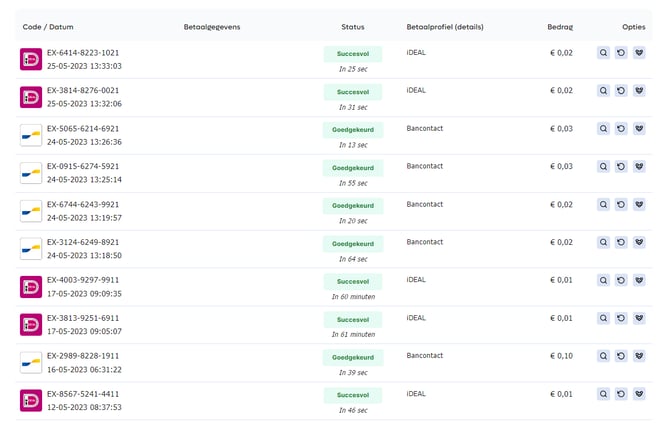
Viewing All Transactions
To be able to view all transactions, follow the steps below:
-
In the Admin Panel, go to the Transactions » Overview https://admin.pay.nl/transactions tab.
-
The table shows the last 10 payment attempts Image: Table with All Payment Attempts. You can, if desired, change the number of results per page via the configuration link at the bottom right of the menu. Using the navigation bar below the table, you can view the results on the next page.
Reversing a Transaction
Via the transaction overview, you can easily reverse paid transactions. A detailed explanation can be found here.
Availability
Below you will find in which packages the 'Transaction Overview' is available.
 Pioneer Pioneer |
 Professional Professional |
 Business Business |
 Corporate Corporate |
|
|---|---|---|---|---|
| Transaction overview | ✔️ | ✔️ | ✔️ | ✔️ |
Transaction Details
General Transaction Details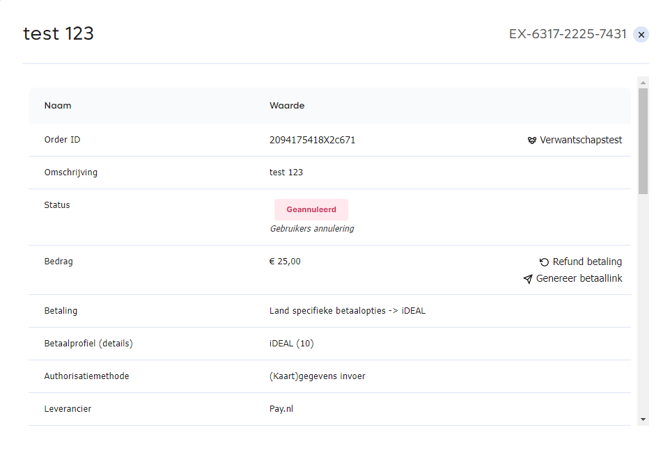
Transaction Workflow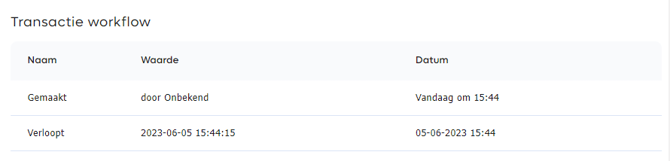
Customer Details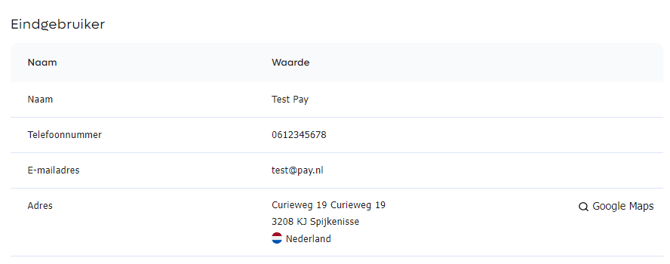
Product Details
Communication Details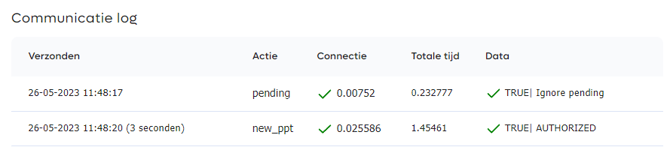
The transaction overview shows the most important characteristics of a transaction. To view all the details of one specific transaction, click the magnifying glass icon or the EX code. A popup then opens with the transaction details below:
General Transaction Details
At the top of the popup, the most important details Image: General Transaction Details are shown, such as the amount, the order number, the name of the webshop, and the chosen payment method. Via the 'refund payment' link, you can directly reverse a payment from the popup to the customer.
Authorization Method
For an increasing number of payment options, such as iDEAL, Bancontact, Alipay, and WeChat Payment, authorization can also take place via a QR code. Below you will find the options.
- Card Details Entry / Bank Selection
- Mobile 2 APP
- QR 2 APP Payment
Transaction Workflow
In the transaction workflow Image: Transaction Workflow, you will find the various steps a transaction has gone through. By default, this shows the date / time when the transaction was started and when it was paid out to the merchant via a clearing. In addition, you can also find any refunds here.
End User Details optional
If the plugin or API you use forwards the customer details, you will find them under 'End User'. Image: Customer Details
Product Details optional
If the plugin or API you use forwards the product details, you will find them under 'Products'. Image: Product Details
Communication Details optional
If the plugin or API you use has set up a communication URL, you will find all calls related to this transaction under 'Communication Information'. Image: Communication Details
Availability
Below you will find in which packages the 'Transaction Details' are available.
| Pioneer |
Professional |
Business |
Corporate |
|
|---|---|---|---|---|
| Transaction details | ✔️ | ✔️ | ✔️ | ✔️ |
Other Currencies
Conversion for Transactions in a Different Currency
PAY. is a Dutch PSP and pays out in euros. However, with Pay. you can let consumers pay in the local currency. Payments received are converted to EUR based on the current daily exchange rate.
From your webshop, you pass a currency code to our API. The payment is then displayed on the payment screen in the same currency you offer in your webshop, so if you offer your product in USD, the payment is displayed in USD. Any exchange rate difference between EUR and USD is for the merchant. If you start the payment in EUR and the customer pays in USD, the exchange rate difference is for the consumer.
Because the daily exchange rate also changes during the day itself, the amount that is debited can differ from the amount with which the transaction was started.
Refund of a Transaction in a Different Currency
There are 2 options:
-
Refund in Original Currency: Before we send the refund to the payment option, a conversion takes place based on the daily exchange rate. If the amount in EUR is equal, the refund is sent. If the refund amount in EUR is higher after conversion, you will receive an error message. This only occurs with the payment option Credit Card. You can find more information about the maximum refund amounts per payment option here. If the consumer has a payment account in a different currency, the consumer's bank converts the payment to the original currency
-
Refund in EUR: We send the amount in EUR to the payment option. If the consumer has a payment account in a different currency, the consumer's bank converts the payment to the original currency
Because the daily exchange rate also changes over a longer period, the amount in the original transaction can deviate positively or negatively from the amount with which the transaction was started.
Cash Flow Involved
Transaction not received from the payment option.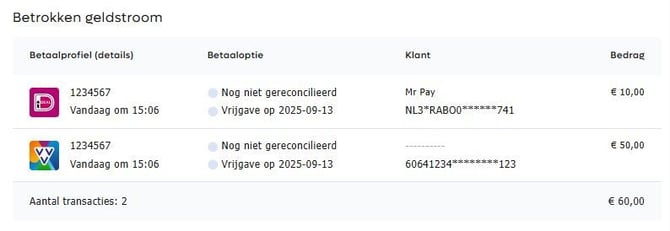
Transaction received and paid out.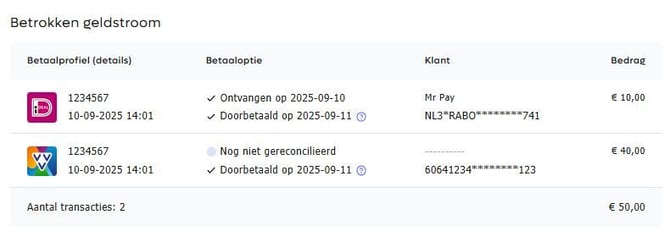
When you receive a transaction, we place the revenue directly in your account balance. However, we do not receive these funds directly from our payment options. Because we cannot pass on funds before they have come in, we pay them out according to the payout terms. The payout differs per payment option. An overview per payment option can be found in the Payout Speed table
From the Pioneer package onward, it is possible to see at the transaction level whether funds from the (pay-later) payment option have been received. If funds have not been received, PAY. will usually not pay out. In the Transaction Information popup in the Cash Flow Involved table, this will be visible as follows:
1. Transaction Not Yet Reconciled
As indicated above, PAY. only pays out funds once they have been received and checked. We call this reconciling. In the image on the right, we see a partial transaction. The VVV Cadeaukaart transaction has not yet been received from the payment option and has therefore not yet been released. Based on the payout term, we communicate the date on which the transaction will be released. Clearing takes place according to the configured Clearing Frequency.
You will also see an iDEAL payment. We have received the funds for this payment option on 12-09-2025. We release the transaction on 13-09-2025. The payout takes place according to the configured Clearing Frequency.
2. Transaction Received/Released/Paid Out
In the image on the right, we again see a partial transaction. The VVV cadeaukaart transaction has been received, released, and paid out. The same applies to the iDEAL payment. By hovering your mouse over the question mark, an ALT tag appears containing the Clearing reference under which the transaction was paid out. You can look up the Clearing reference in the Clearing History.
Partial Payments
It is possible to receive partial payments via Pay.nl. This allows a customer to pay part of the amount with a gift card (see here for a complete overview of the different gift cards) and the remaining amount with another gift card or payment option. The process of a partial payment can differ depending on how the remaining payment is made. Here we explain a few important points:
-
The customer starts their payment and enters the gift card details. We check the details and carry out an authorization on the gift card; only once the remaining payment has succeeded do we set the gift card payment to PAID and deduct the balance from the card.
-
For a partial payment with a gift card and a remaining payment via a pay-later option, the process is slightly different. In this case, we carry out a direct capture on the gift card. If 'Direct Capture' applies to the pay-later option, we will also carry out a direct capture on the remaining payment. If 'Delayed Capture' applies, a capture or release still needs to take place on the pay-later transaction.
-
For a partial payment, we will cancel the transaction if no payment has been completed within 30 minutes.
-
For a partial payment with a pay-later option, we will automatically refund the funds to the gift card when the pay-later option is released (cancelled).
For more information about refunding a partial payment, this page can be consulted.
Filtering Transactions
Select Period
Select Filter
Select View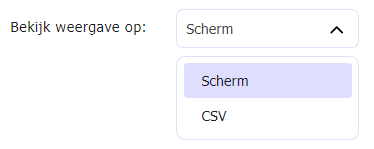
At the top of the transaction overview, you will find the option to search for transactions, where the following options can be used:
-
Period
Select the period Image: Select Period for which you want to display transactions, such as today, the last 7 days, last month, a custom period, etc.
-
Filter
Use a filter Image: Select Filter to search on a particular property such as payment method, status, amount, customer characteristic, etc. By clicking the green plus icon, you can add multiple filters. You can find more information about filters here.
-
View Display On
By default, all transactions are shown in the table (screen) Image: Select View. From the Professional package onward, however, you can also choose the 'CSV' option, which generates a CSV file with all transactions that fall within the search.
Availability
Below you will find the available display options per package
| Pioneer |
Professional |
Business |
Corporate |
|
|---|---|---|---|---|
| Table (screen) | ✔️ | ✔️ | ✔️ | ✔️ |
| Output to CSV | ✖️ | ✔️ | ✔️ | ✔️ |
Transaction Statuses
Reserved Transactions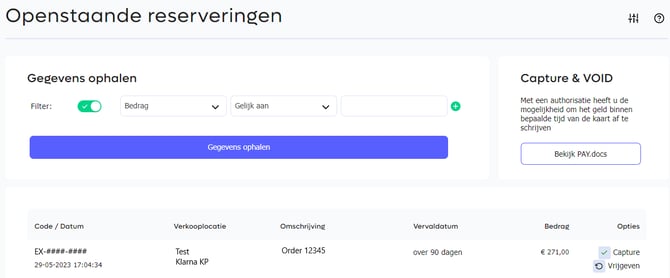
Capturing or Voiding (Releasing) a Transaction
Capturing or Voiding (Releasing) a Transaction from the Transaction Popup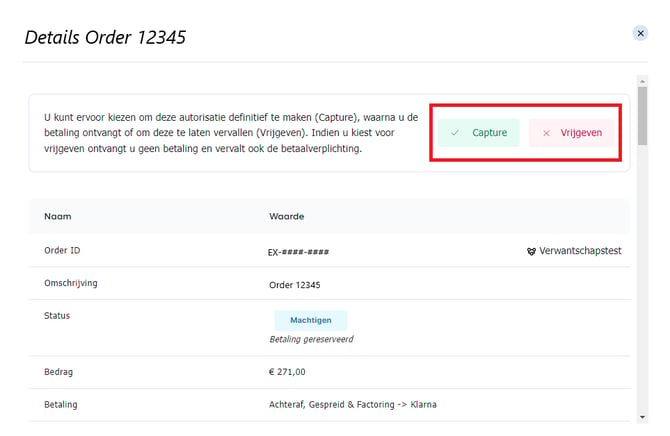
For certain pay-later and credit card transactions, it is possible to create a reservation that can later be converted into a payment (capture) or into a cancelled transaction (void, also referred to as released)
By default, transactions for which a reservation is possible are captured directly. If you want to use 'delayed capture', contact your account manager to discuss the options.
There are 2 ways to convert a reserved transaction into a capture or a void
- Via the overview of reserved transactions
- Via the transaction details popup
1. Via the Overview of Reserved Transactions
-
In the Admin Panel, go to the Transactions » Reservations https://admin.pay.nl/transaction/reservations tab.
-
Under 'Open Reservations' you will see an overview of all reserved transactions Image: Reserved Transactions. In the options column, you can convert the transaction into a payment by clicking 'capture'. If you want to cancel the transaction, click release (void).
2. Via the Transaction Details Popup
-
Via the Dashboard or the Transaction Overview, you can open the transaction details popup.
-
If it concerns a reservation, at the top of the popup you will see the option to capture or release (void) the transaction. Image: Capturing or Voiding (Releasing) a Transaction from the Transaction Popup
.
A reservation can only remain open for a certain period of time. If you do not convert the transaction into a capture within the maximum reservation period, the transaction is automatically released by default. However, it is also possible to use an auto capture after x days. Your account manager can help you set this up.
Payment Options for Which the Capture/Void Action Applies
| Payment option | Type of payment option | Default capture time | Max capture time | Payment Setting |
|---|---|---|---|---|
 |
Payment by invoice | 14 days | 90 days | Delayed capturing |
 |
Payment by invoice | 14 days | 90 days | Delayed capturing |
 |
Payment by invoice | 14 days | 90 days | Delayed capturing |
 |
Credit card | 7 days | 7 days | Reservation |
 |
Credit card | 30 days | 30 days | Reservation |
|
Credit card | 14 days | 14 days | Reservation |
Transaction Statuses
Status Flow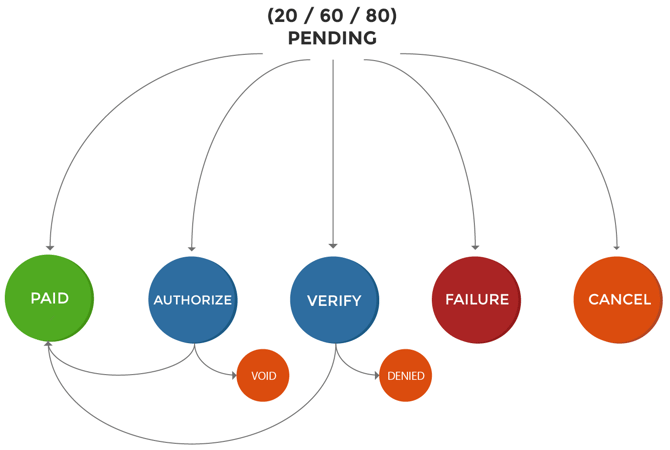
For 99% of transactions, they receive the status PENDING when the transaction is created, and then the status PAID once it has been paid successfully, or the status CANCEL if the payment has failed. However, there are also a number of other statuses used within PAY.'s platform. A full overview can be found in the table below.
It is technically possible for a PAID status to follow a CANCEL, for example if a malfunction occurs at a payment option, or if the customer opens multiple screens and 1 payment is cancelled.
Statuses
| Code | Status | Description |
|---|---|---|
| Common statuses | ||
| -90 |  CANCEL CANCEL |
The payment has been cancelled |
| -80 | EXPIRED |
The payment has expired |
| -72 |  REFUNDING REFUNDING |
The payment is being refunded (you can still cancel it) |
| -81 | REFUND |
The payment has been refunded |
| 20 25 |  OPENING OPENING |
The final status of the payment is not yet known. |
| 50 | SUCCESS_PENDING |
The customer has been successfully redirected to the payment environment; however, the final status of the payment is not yet known. |
| 85 |  VERIFY VERIFY |
The payment has been marked as irregular. The status must be determined by an additional check. |
| 90 | OPENING |
The payment has not yet been received in our escrow account and is therefore not yet guaranteed. |
| 95 | AUTHORIZE |
The payment is reserved and can be captured. This status occurs with credit cards and some pay-later methods. |
| 97 | PARTLY_CAPTURED |
The payment has been partially captured - a portion is still in AUTHORIZE. You can CAPTURE or VIODEN the remainder of the value. |
| 80 | PARTIAL PAYMENT |
Partial payment, applicable to gift cards with which the full amount has not been paid |
| 100 |  PAID PAID |
The payment is successful |
| Other statuses | ||
| -51 | PAID CHECKAMOUNT |
Payment cancelled because the amount paid by the customer does not match the original order amount |
| -60 |  FAILURE FAILURE |
The payment was interrupted due to an unexpected error with the payment option. |
| -63 | DENIED |
The payment was declined by the payment option. For pay-later methods, this means that the customer did not pass the credit check. |
| -64 | DENIED |
The payment has been rejected due to an action by an employee or external system. |
| -71 | CHARGEBACK |
Credit card payment chargeback |
| -82 | PARTIAL REFUND |
The payment has been partially refunded |
| -95 | REJECTED |
The payment has been rejected by the payment option |
- Status code: 100 (PAID): The payment is successful
- Status code: NEGATIVE: The payment has been cancelled or reversed
- Status code: POSITIVE: The payment is still pending, no final status is known yet
Success Overview
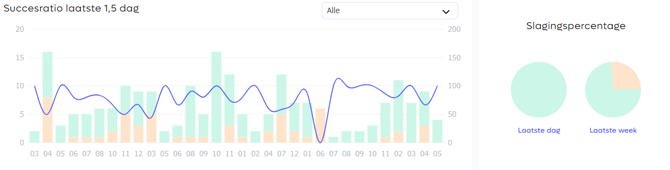
Above the table with transactions, you will see a graphical overview of successful payments Image: Success Overview. These graphs show the success rates for:
-
Last 36 Hours
In the bar chart on the left, one bar represents one hour. The bar shown is made up of cancelled, expired, and paid transactions. The blue line represents the percentage of successful transactions per hour.
-
Last Day
Pie chart showing the percentage of cancelled, expired, and paid transactions for the last day.
-
Last Week
Pie chart showing the percentage of cancelled, expired, and paid transactions for the last week
Success Overview for a Payment Option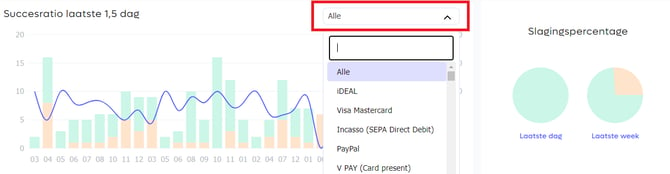
By hovering your mouse over the graphs, you get more information. By default, the results for all transactions are shown. However, in the selection box you can also select individual payment methods Image: Success Overview for a Payment Option. This way, you can, for example, retrieve the success percentages for credit card payments.
Availability
Below you will find in which packages the 'success overview' is available.
| Pioneer |
Professional |
Business |
Corporate |
|
|---|---|---|---|---|
| Passing Overview | ✔️ | ✔️ | ✔️ | ✔️ |