
⚠️ Pilot feature
Statement Descriptors are currently in the pilot phase. This feature cannot yet be activated directly through the Merchant Dashboard.
Would you like to participate in the pilot and enable Statement Descriptors? Please contact support@pay.nl.
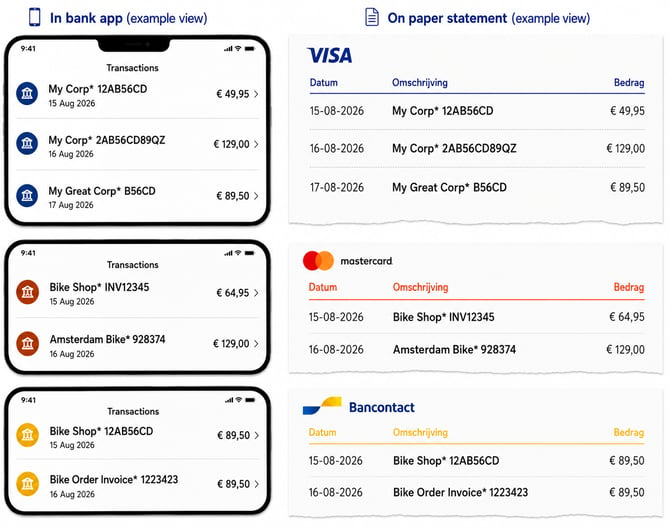
A Statement Descriptor works by adding an extra, recognizable description to the card transaction, appended after the trade name. This addition can, for example, contain a order, reservation, or reference number. This makes it easier for the merchant to use the descriptor to determine which specific transaction a payment belongs to.
Change "Your Company Name" on the statement to: Your Company Name* A64SKF2
Allowed Characters
Only alphanumeric characters are allowed (A-Z, a-z, 0-9). Spaces and special characters are not allowed.
Advice
We recommend using only uppercase letters, so that the description is displayed as consistently as possible across different banks and card networks.
For example:
✅ MYCORP123
❌ My Corp 123 — contains spaces
❌ MY-CORP — contains a hyphen
❌ MYCORP#123 — contains a special character
Use only alphanumeric characters (A-Z, 0-9) and - Spaces and special characters are not allowed. The use of uppercase letters is recommended.
Activate
The Statement Descriptor can be activated via the Merchant Dashboard. Once activated, an additional description can be added to the trade name for card payments, making individual transactions easier to recognize and trace.
From order.reference to the Statement Descriptor
When the statement descriptor is based on the payment reference, PAY combines the merchant's tradename and the payment reference into one descriptor.
The maximum descriptor length used by PAY is 22 characters.
Format
{tradename}* {reference}
The separator * uses 2 characters.
Rules
- If the complete tradename + separator + reference fits within 22 characters, we show both in full.
- If the combined value exceeds 22 characters, we first shorten the reference, keeping the last characters of the reference.
- We always show at least the last 6 characters of the reference when reference-based statement descriptors are enabled.
- If keeping 6 characters of the reference still does not fit, we shorten the tradename.
- Therefore, the maximum tradename length is 14 characters when a reference is included:
14 + 2 + 6 = 22. - If a merchant wants more of the reference to be visible, they must configure a shorter tradename.
Examples
| Use case | Tradename | Reference | Original length | Result | Consequence |
|---|---|---|---|---|---|
| Both fit | My Corp (7) |
12AB-56CD (9) |
7 + 2 + 9 = 18 | My Corp* 12AB-56CD |
None |
| Long reference | My Corp(7) |
12AB-56CD-89QZ (14) |
7 + 2 + 14 = 23 | My Corp* 2AB-56CD-89QZ |
Remove characters from the start of the reference until the descriptor fits |
| Long tradename | My Great Corporation (20) |
12AB-56CD(9) |
20 + 2 + 9 = 31 | My Great Corpo* B-56CD |
Tradename is shortened to 14 characters; only the last 6 characters of the reference are shown |
In other words, when truncation is required, the priority is:
Tradename → * → last part of reference
with at least 6 reference characters preserved.
Scheme limits
| Scheme | Allowed | Scheme maximum | PAY maximum |
|---|---|---|---|
| Visa | Yes | 25 YEARS | 22 |
| Mastercard | Yes | 22 YEARS OLD | 22 |
| Amex | Yes | 83 bytes ANS | 22 |
| Bancontact | Yes | 22 YEARS OLD | 22 |
Bancontact
For Bancontact, some banks can also display the payment description on the bank statement instead of, or in addition to, the payment reference.
Example order:
- Reference:
12AB-56CD-89QZ - Description:
Bike order invoice #1223423